



Key Takeaways:
- One Word, Precise Meaning: Nama translates to "raw" or "fresh" in Japanese, and in chocolate, it’s a category defined by a smooth, velvety texture.
- Hokkaido Cream Is The Foundation: The high moisture content from fresh Hokkaido cream gives Nama Chocolate its signature soft, yielding bite.
- Freshness Has Requirements: Because Nama Chocolate is made with real fresh cream, it must be kept in refrigeration storage and enjoyed within its shelf life to experience it as intended.
What does Nama mean in Japanese? You’ve probably seen this word on premium Japanese chocolate packaging, and maybe you thought it’s a flavor. Long story short, this term means “raw” or “fresh,” and in the context of chocolate, it carries a precise technical and sensory promise.
At ROYCE' Chocolate, our Nama Chocolates have been the bestselling cornerstone of what we craft in Hokkaido since 1995. So, knowing what Nama refers to is key to figuring out exactly what you’re getting when you open our signature boxes.
In this article, we’ll cover the word's meaning, what it requires in production, how it translates to taste, and why it matters when choosing a confection.
The Meaning And Everyday Use Of Nama In Japanese
The word "Nama" is part of everyday Japanese vocabulary, appearing in many contexts. Knowing how it functions in the language before it enters the world of chocolate gives its confection solid grounding.
The Literal Translation Of Nama
"Nama" is a Japanese adjective meaning raw, fresh, or unprocessed. That said, it applies broadly. For example, nama biru means draft beer served fresh from the tap, nama yasai refers to raw vegetables, and nama tamago means a raw egg. In every case, the word emphasizes an absence of processing, something delivered in its most natural, immediate state, prioritizing the integrity of the original ingredient over transformation.
How Do You Say Chocolate In Japanese? Where Nama Fits
The word for chocolate in Japanese is "chokoreeto," a loanword adapted from Western languages. "Nama Chocolate" therefore combines a native Japanese word with a foreign borrowing, creating a compound that refers to a sweet treat that retains the freshness and moisture of its core ingredient. The pairing produces a category, not just a description, and that distinction matters in how the product is made and stored.

What Nama Means In Chocolate Specifically
The literal meaning of "fresh" or "raw" tells part of the story. In chocolate, "Nama" refers to a specific category with defined characteristics that distinguish it from other confections.
High Moisture Content As The Defining Feature
What sets Nama Chocolate apart is its moisture content. The intentional inclusion of fresh Hokkaido cream produces a ganache-style confection with a significantly higher moisture level than shelf-stable chocolates. That moisture is what delivers the characteristic softness, yielding under the slightest pressure and melting evenly and fully on the palate. It’s the Hokkaido cream's inherent freshness that makes this texture possible, and it also makes refrigeration necessary.
The Role Of Hokkaido Cream
Our Nama Chocolates are made with fresh cream sourced from Hokkaido, Japan's northernmost island, known for its cool climate and rich natural resources. That origin isn’t incidental. The quality of the cream directly determines the richness, smoothness, and the way each piece releases flavor as it melts. Our piece on Sweets 101: Get to Know Our Nama Chocolate “Au Lait" shares fun trivia, from how “Au Lait” got its name to its 2013 award.
Precisely Cut, Cocoa-Dusted Rectangles
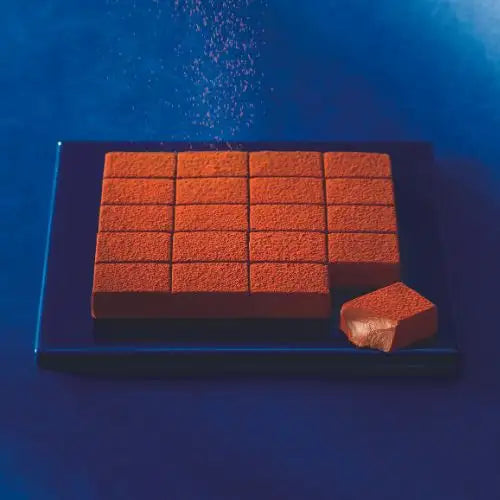
Unlike traditional truffles, which are typically hand-rolled into rounds, our Nama Chocolate is cut into symmetrical, delicate rectangles per box and finished with a fine dusting of cocoa powder. That crisp cut edge reveals the interior texture and signals exactness in production. The cocoa dusting adds a faintly bitter counterpoint to the velvety interior, completing the harmonious balance of elements in every piece.
How Nama Chocolate Differs From Other Chocolate Styles
When placing Nama alongside other chocolate delicacies, it’s easy to see how it stands out.
Nama vs. Ganache
Ganache is the closest structural relative, as both are cream-based and soft. The distinction is that ganache most commonly appears as a filling inside a harder shell, serving the interior of a bonbon rather than standing alone. By contrast, Nama Chocolate is a standalone, precisely cut format consumed as the primary experience rather than as a separate component within a shell.
Nama vs. Chocolate Bar
A standard chocolate bar is designed for room-temperature storage and extended shelf life. Plus, its lower moisture content makes it more stable across a wide range of conditions. Nama Chocolate, while stable on its own, focuses on using fresh Hokkaido cream for a more immersive tasting experience that delivers a richer mouthfeel, a velvety melts-in-your-mouth texture, and a creamier flavor profile. The trade-off to consuming our Nama Chocolates is that they require refrigeration and a shorter shelf life compared to room-temperature confections. That said, both formats are valid and shine in their own way.
The Flavors Available for ROYCE’ Nama Chocolates
Our Nama Chocolate is more of a confection format instead of an item with a single flavor. This means that there is a good range of different flavors that suit various taste profiles. Discerning palates may enjoy our Nama Chocolate “Ghana Bitter”, a liquor-free dark chocolate confection. Meanwhile, those who like confections that are milky and chocolatey would enjoy our liqueur-infused Nama Chocolate “Au Lait” or our liquor-free Nama Chocolate “Mild Milk”. White chocolate enthusiasts may also find themselves drawn to our Nama Chocolate “Matcha” or our Nama Chocolate “Mild White”. If you’re looking to share with your family, we also clearly list whether our Nama Chocolates contain liquor. For further reading, 'Tis the Season to Indulge in Nama Chocolate shows how ROYCE’ brings a touch of luxury to every festive gathering with delectable goodies.

How To Store And Enjoy Nama Chocolate Properly
Understanding Nama Chocolate also means learning about the practical requirements that come with it.
Why Refrigeration Is Needed
All Nama Chocolates must be stored at 50 degrees Fahrenheit or below due to the fresh Hokkaido cream content that majorly defines its consistency. Leaving them at room temperature destabilizes the cream, causing the texture to lose its defining softness. When shipped, our Nama Chocolates arrive in an insulated box with dry ice (or in some cases, with an extra cooling agent such as an ice gel block) to maintain that optimal temperature from our facility to your refrigerator.
Eating Nama Chocolate At Its Best
Nama Chocolate is best enjoyed slightly chilled rather than straight from a cold refrigerator. Allowing a few minutes at room temperature before eating lets the texture soften just enough to deliver the full melt-in-your-mouth experience, a small habit that returns a noticeably rewarding result every time.

Final Thoughts
"Nama" is a single Japanese word that embodies a standard of freshness, precision, and sensory commitment. Knowing what it means transforms opening a box from a pleasant moment into an informed one. At ROYCE' Chocolate, we have built our signature collection around this word since 1995, using fresh Hokkaido cream and careful production to make sure every piece lives up to the promise the name makes.
Frequently Asked Questions About What Nama Means In Japanese
Is Nama Chocolate the same as a truffle?
Nama Chocolate and truffles share a cream-based ganache structure but differ in form. Nama Chocolate is precisely cut into rectangles and served as a standalone piece rather than hand-rolled.
When were ROYCE' Nama Chocolates introduced?
Our Nama Chocolates were launched in 1995, following the Chocolate Bar “Milk” in 1985 and Pure Chocolates in 1990 as our earlier signature products.
Do all Nama Chocolate flavors require refrigeration?
Yes. All Nama Chocolates must be stored at 50 degrees Fahrenheit or below.
Are there liquor-free Nama Chocolate options available?
Yes. Several flavors in our Nama Chocolate collection are liquor-free, and each product is clearly labeled so the distinction is easy to see before purchase.
How many pieces come in a single box of Nama Chocolate?
Each individual box of our Nama Chocolate contains 20 precisely cut rectangular blocks dusted with fine cocoa powder.
Can Nama Chocolate be shipped in warm weather?
Yes. Our Nama Chocolates are shipped in an insulated packaging container with dry ice to help maintain the required temperature throughout transit.

